
Sweepstakes Casino Legal States 2026: Complete US Map
 Available in US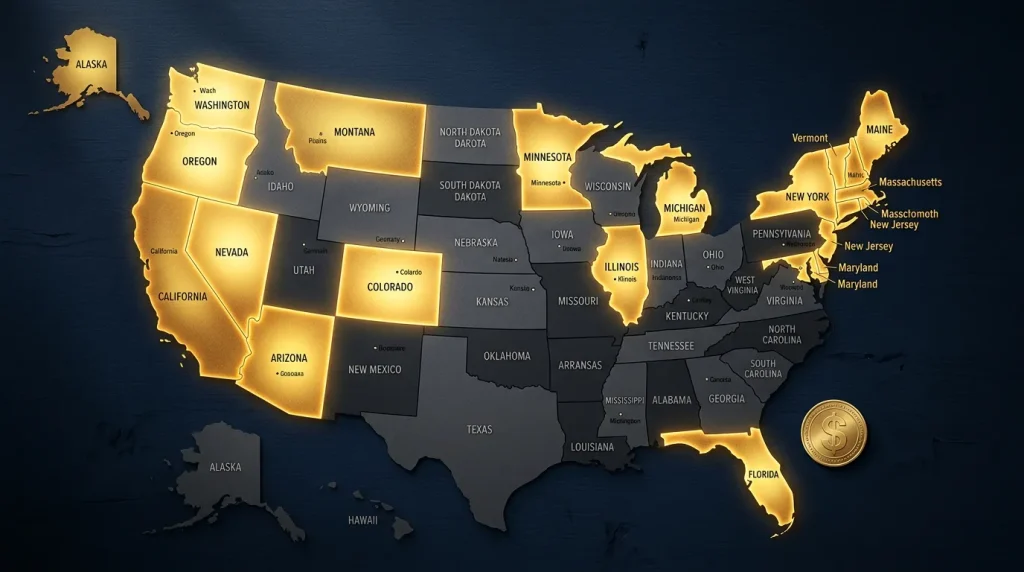
Contents
Sweepstakes casinos operate in a legal gray area that confuses players and frustrates regulators in equal measure. Unlike traditional online gambling—which remains legal in only seven US states—sweepstakes platforms have expanded into more than 35 states by exploiting a promotional model originally designed for fast-food giveaways and mail-in contests. The question of legality isn’t academic. It determines whether you can actually cash out your winnings or find yourself locked out of a platform overnight.
The sweepstakes model sidesteps gambling laws through a technical workaround: players purchase virtual currency (Gold Coins) for entertainment, receive free Sweeps Coins as a promotional bonus, and can redeem those Sweeps Coins for real prizes. Because participants don’t directly wager money on games of chance—at least on paper—operators argue their platforms don’t constitute gambling. Regulators increasingly disagree. California banned sweepstakes casinos in 2026. New York followed with aggressive enforcement action. Washington state considers them flatly illegal under existing gambling statutes.
For players, understanding where sweepstakes casinos are legal isn’t just about access—it’s about protecting your money. When states crack down, platforms often exit markets with minimal notice. Players who haven’t met playthrough requirements or verification deadlines may lose unredeemed balances. The legal landscape changes frequently as state legislators introduce new bills and attorneys general take enforcement actions.
This guide maps the current legal status across all 50 states, explains the regulatory framework that determines legality, and examines pending legislation that could reshape the industry by the end of 2026. Know before you play: that’s the principle that separates informed players from those caught in regulatory crossfire.
Understanding the Legal Framework
The legal status of sweepstakes casinos hinges on a three-element test that defines gambling under most state laws: consideration, chance, and prize. Traditional casinos require all three—you pay money (consideration), outcomes depend on luck (chance), and you can win money (prize). Sweepstakes operators attempt to remove consideration from the equation by structuring their business model around promotional giveaways rather than direct wagers.
Here’s how the model works mechanically. Players purchase Gold Coins, a virtual currency used exclusively for entertainment with no cash value. As a bonus—never as a purchase—players receive Sweeps Coins, which can be redeemed for cash prizes. Critically, platforms must offer an alternative method of entry (AMOE) that requires no purchase at all. Most commonly, this takes the form of mail-in requests, where anyone can send a handwritten letter to receive free Sweeps Coins. Some platforms also offer daily login bonuses or social media promotions.
The legal theory underlying this structure comes from legitimate promotional sweepstakes—the kind McDonald’s runs for Monopoly pieces or Coca-Cola operates through bottle cap codes. Those promotions have long been legal because participants can enter without purchase. Sweepstakes casinos borrow this framework but apply it to casino-style games, which is where legal challenges emerge.
States evaluate legality differently based on their gambling statutes. Some define gambling narrowly around direct wagering, which allows sweepstakes models to operate. Others use broader definitions that encompass any game of chance with real-prize potential, regardless of whether direct payment is required to participate. A few states, like Washington, have particularly expansive gambling laws that capture virtually any prize-based gaming.
Federal law adds another layer of complexity. The Unlawful Internet Gambling Enforcement Act (UIGEA) prohibits businesses from accepting payments for illegal internet gambling, but the law’s enforcement focuses on traditional gambling operations rather than promotional models. No federal agency has taken definitive action against sweepstakes casinos as a category, leaving regulation primarily to individual states.
The absence of federal oversight means players face a patchwork of state-level regulations. What’s explicitly legal in Texas might be explicitly illegal in Connecticut. What’s tolerated in Florida might be actively prosecuted in New York. This inconsistency creates genuine uncertainty for players, who must verify legality in their specific state before registering—and monitor changes that could affect their status.
States Where Sweepstakes Casinos Are Legal
Sweepstakes casinos currently operate legally in approximately 40 states, though the precise count fluctuates as enforcement actions and new legislation reshape the landscape. The states where major platforms accept players without restriction share a common characteristic: their gambling laws either explicitly permit promotional sweepstakes or haven’t been interpreted to prohibit them.
The largest player populations cluster in states with permissive regulatory environments and no competing legal online gambling market. Florida, which accounts for roughly 8.5% of sweepstakes operator revenue—translating to more than $1 billion in player purchases—exemplifies this pattern. With no legal online casinos and a population that skews older, Florida provides sweepstakes platforms with an eager customer base that has no alternative for legal online casino-style gaming.
Texas presents a similar dynamic. The state prohibits traditional casino gambling both online and at physical locations, yet its gambling statutes focus on direct wagering rather than promotional models. Major sweepstakes platforms operate freely, serving a population of nearly 30 million with an appetite for gaming that has no licensed outlet. The same logic applies to Ohio, Pennsylvania (outside the regulated iGaming market), Georgia, Tennessee, and other states where casino gambling remains restricted.
Some states with legal brick-and-mortar casinos nonetheless permit sweepstakes operations. Nevada, surprisingly, allows sweepstakes casinos despite its dominant position in traditional gambling. The state’s gaming commission hasn’t moved to restrict promotional models, perhaps because sweepstakes platforms don’t directly compete with the Las Vegas experience. Colorado, Arizona, and Michigan similarly host both regulated iGaming markets and sweepstakes platforms, though this coexistence may not last as traditional operators push for regulatory parity.
States in the Southeast generally permit sweepstakes casinos. Alabama, Mississippi, Louisiana, Arkansas, and South Carolina all allow major platforms to operate, though Louisiana issued 40 cease-and-desist letters to unregulated operators in 2026—signaling that tolerance has limits. The distinction matters: platforms operating in compliance with promotional sweepstakes laws remain legal, while those that fail to implement proper AMOE provisions or other safeguards face enforcement.
The Midwest shows broad acceptance as well. Iowa, Kansas, Missouri, Nebraska, North Dakota, and South Dakota all permit sweepstakes casinos. Minnesota, Wisconsin, and Illinois operate in similar fashion. These states typically have limited online gambling options and haven’t prioritized enforcement against promotional models.
New England remains split. Massachusetts, Rhode Island, and Maine permit sweepstakes operations. Vermont and New Hampshire likewise allow platforms to accept players. Connecticut, however, stands as an exception—the state’s compact with tribal gaming interests led to restrictions that effectively ban sweepstakes casinos alongside unauthorized online gambling.
Players in legal states should still verify specific platform availability. Individual operators make their own determinations about which states to serve based on legal assessments, and these determinations don’t always align with broad legal interpretations. A state being generally permissive doesn’t guarantee that every platform will accept registrations from that state.
States With Bans
Seven states have either explicitly banned sweepstakes casinos or interpreted existing gambling laws to prohibit them: California, Connecticut, Idaho, Montana, New Jersey, New York, and Washington. Each arrived at prohibition through different legal mechanisms, and the consequences for players vary accordingly.
California
California’s ban, enacted through AB 831 in October 2026, represents the most significant regulatory action against the sweepstakes industry. The state accounts for 17.3% of the entire US sweepstakes market—approximately $2.42 billion in player purchases annually, according to an economic impact study by Eilers & Krejcik and the Social Gaming Leadership Alliance. Losing California dealt sweepstakes operators a body blow that analysts predict will reshape the industry.
The ban emerged from pressure by tribal gaming interests, who argued that sweepstakes casinos violated their compact-granted exclusivity over casino gaming. Traditional card rooms joined the coalition, concerned about competition from unregulated online platforms. Governor Gavin Newsom signed the bill despite opposition from sweepstakes operators who claimed the model remained legally distinct from gambling. Platforms had until January 2026 to exit the market, and most major operators complied—though some attempted workarounds that drew immediate regulatory attention.
New York
New York took a different approach, classifying sweepstakes casinos as illegal gambling under existing law and pursuing enforcement through the Attorney General’s office. In 2026, Attorney General Letitia James sent cease-and-desist letters to 26 platforms, ordering them to stop accepting New York players immediately. The state subsequently passed S5935, which explicitly defines sweepstakes casinos as illegal gambling and establishes civil penalties.
The financial stakes in New York were substantial. Eilers & Krejcik estimated the New York market at $762 million in 2026 sales—making it the second-largest state market after California. The ban eliminated a major revenue source for operators and displaced hundreds of thousands of active players.
Senator Joseph P. Addabbo Jr., who championed the legislation, articulated the regulatory position clearly: “If a game on your phone or computer looks like a casino game, acts like a casino game, and pays out real money winnings like a casino game, then it is a casino gambling game, thus currently illegal and should not operate in New York without proper regulation, safeguards, and accountability.”
Washington
Washington state’s prohibition predates the recent wave of enforcement actions. The state’s gambling laws are among the most restrictive in the nation, capturing virtually any game of chance that offers prizes of value. Sweepstakes casinos have been effectively illegal in Washington since they first emerged, and the state’s gambling commission actively monitors for violations. Unlike California and New York, where bans resulted from specific legislative or enforcement actions, Washington’s prohibition stems from longstanding statutory interpretation.
Other Banned States
Connecticut’s ban relates to exclusive gaming compacts with the Mohegan and Mashantucket Pequot tribes, which control casino gaming in the state. Idaho, Montana, and New Jersey have interpreted their gambling statutes to prohibit sweepstakes casino operations, though enforcement intensity varies. New Jersey’s position is particularly notable given the state’s otherwise progressive approach to online gambling—the distinction lies in regulatory control, which licensed iGaming operators have and sweepstakes platforms lack.
Players in banned states face immediate account restrictions upon detection. Platforms use IP geolocation and identity verification to block registration and may void balances for players discovered to have misrepresented their location. The consequences extend beyond lost funds: violations of state gambling laws can theoretically result in criminal charges, though prosecution of individual players remains rare.
Pending Legislation
The legislative landscape for sweepstakes casinos remains volatile, with bills introduced in multiple states that could either ban or regulate the industry. The direction of these proposals generally reflects whether traditional gaming interests hold sway in the state legislature.
Illinois has emerged as a key battleground. The state’s licensed casino operators have pushed for legislation that would either ban sweepstakes casinos outright or subject them to the same regulatory framework—and tax burden—as traditional iGaming. With Chicago’s new casino investment at stake, industry lobbyists argue that unregulated sweepstakes platforms undermine the licensed market. Legislation introduced in early 2026 would classify sweepstakes casinos as gambling and require state licensing, effectively ending the current model.
Michigan presents a similar dynamic. The state legalized iGaming in 2019 and has watched sweepstakes platforms capture market share outside the regulated framework. Tribal gaming interests, who negotiated compacts with specific revenue expectations, have expressed frustration with the competitive imbalance. Bills under consideration would extend gambling definitions to cover promotional models, though the proposals face opposition from free-market advocates who argue that sweepstakes represent legitimate promotional activity.
Florida’s situation deserves particular attention given the state’s outsized role in the sweepstakes market. The Seminole Tribe, which operates under a gaming compact that grants exclusivity over casino gaming, has challenged the legality of sweepstakes casinos in both courts and the legislature. While no ban has passed, multiple bills have been introduced, and the tribe’s political influence makes future restrictions plausible. Players who rely on sweepstakes as their primary gaming option should monitor Florida legislative sessions closely.
Some states are considering regulatory frameworks rather than outright bans. Ohio legislators have proposed licensing requirements that would bring sweepstakes casinos under state oversight while allowing continued operation. The model would require platforms to register, pay fees, implement responsible gaming measures, and potentially share revenue with the state. Similar proposals have appeared in Pennsylvania and Indiana, where regulators see potential tax revenue that currently escapes state coffers.
The federal level remains largely quiet. While individual members of Congress have criticized the sweepstakes model, no comprehensive legislation has gained traction. The complexity of gambling regulation—traditionally a state matter—makes federal intervention politically challenging. The most likely federal action would come through enforcement of existing laws rather than new legislation, potentially through DOJ interpretation of wire fraud or UIGEA provisions.
Players should track legislative calendars in their home states, particularly if those states have active iGaming markets or strong tribal gaming interests. Bills can move quickly once introduced, and platforms typically exit markets immediately when legislation passes rather than waiting for implementation deadlines.
Enforcement Actions 2026-2026
The enforcement environment for sweepstakes casinos has intensified dramatically. More than 100 cease-and-desist letters were issued across US states during 2026 alone—a coordinated effort that signals regulatory patience has expired. The actions targeted both major platforms and smaller operators, with consequences ranging from market exit to substantial fines.
New York led the enforcement wave. Attorney General Letitia James’s office sent cease-and-desist letters to 26 platforms, ordering immediate cessation of operations in the state. The accompanying legislation, S5935, established civil penalties ranging from $10,000 to $100,000 for each violation—with each day of continued operation potentially constituting a separate offense. Platforms that failed to comply faced accumulated liability that quickly reached punitive levels.
Louisiana’s Gaming Control Board issued 40 cease-and-desist letters targeting operators it deemed noncompliant with state gambling laws. The state distinguished between platforms operating genuine promotional sweepstakes—with functional AMOE provisions and legitimate free-entry options—and those using the sweepstakes label as cover for gambling operations. Platforms that could demonstrate legitimate promotional structure received guidance on compliance; those that couldn’t were ordered to exit.
The New York State Gaming Commission, under Chairman Brian O’Dwyer, coordinated enforcement actions with the Attorney General’s office. O’Dwyer publicly characterized sweepstakes operations as threats to consumer protection and state revenue, framing enforcement as essential to maintaining the integrity of New York’s regulated gaming market.
Individual platforms responded to enforcement pressure in varied ways. Major operators exited banned states immediately, implementing geolocation blocks and notifying affected players about account restrictions. Some platforms attempted technical workarounds—operating through offshore subsidiaries or restructuring their currency systems—but these approaches drew rapid regulatory attention and additional enforcement actions.
Smaller operators proved more problematic. Some ignored cease-and-desist letters entirely, calculating that enforcement resources would focus on larger targets. Others relocated corporate structures to jurisdictions outside US legal reach. These operators continue serving players in banned states, though they do so at substantial legal risk—and players who use them face potential complications with withdrawals and dispute resolution.
The enforcement trend shows no signs of slowing. State attorneys general have discovered that sweepstakes enforcement generates positive publicity and aligns with consumer protection messaging. Gaming commissions view unregulated competition as a threat to revenue projections and licensed operators. Players should assume that enforcement will continue expanding to additional states throughout 2026.
What Bans Mean for Players
When a state bans sweepstakes casinos, players face immediate and often frustrating consequences. Understanding what happens—and how to protect yourself—requires cutting through the confusion that typically surrounds enforcement actions.
Account access disappears first. Platforms implement geolocation checks that detect your IP address and compare it against blocked state lists. If you’re in a banned state, you’ll find yourself locked out of your account, unable to play games or access your balance. Some platforms block access immediately upon receiving cease-and-desist letters; others provide a grace period for players to complete verification and withdraw funds.
The withdrawal window matters critically. Most platforms give players between 30 and 90 days to redeem Sweeps Coins and withdraw cash balances after a state ban takes effect. Miss that window, and your unredeemed balance may be forfeit. Players who haven’t completed identity verification face additional pressure—KYC processes that normally take days can stretch to weeks when thousands of players suddenly need verification before the same deadline.
Playthrough requirements become urgent obstacles. If you claimed a welcome bonus with wagering requirements attached, you’ll need to meet those requirements before withdrawing—and you’ll need to do it within the grace period. Players caught mid-promotion may find that the math simply doesn’t work: completing a 1x playthrough on a substantial bonus takes time that a 30-day window might not provide.
Relocation doesn’t provide a clean workaround. Platforms typically restrict accounts based on the address used during registration, not just current location. Moving to a legal state doesn’t automatically restore access to an account registered in a banned state. You may need to contact support, provide proof of new residence, and go through re-verification—assuming the platform permits address changes at all.
The safest approach involves preparation before problems arise. Maintain balances you can afford to lose if access disappears. Complete identity verification early, not when thousands of other players are competing for support attention. Track legislative developments in your state so bans don’t catch you off guard. These precautions won’t prevent the inconvenience of a ban, but they significantly reduce the risk of losing money to regulatory timing. The biggest state ban is analyzed in California AB 831.
The Map Keeps Changing
The legal status of sweepstakes casinos varies dramatically across the United States, and that variation matters more than many players realize. What’s legal in Florida might get you locked out of your account in California. What works today in Illinois might face legislative restriction by next year. The industry’s growth—fueled by availability in states where traditional online gambling remains prohibited—has attracted regulatory attention that shows no sign of diminishing.
Players should approach sweepstakes casinos with clear eyes. Verify legality in your specific state before registering. Monitor legislative developments that could change your access. Maintain reasonable expectations about the stability of your account and the redeemability of your balances. Complete verification early and don’t let promotional bonuses accumulate beyond what you can reasonably clear in a compressed timeframe.
Know before you play. That principle—more than any strategy for maximizing Sweeps Coins or optimizing gameplay—determines whether your sweepstakes experience will be sustainable. The platforms that survive the current regulatory wave will be those that operate legitimately in states where they’re welcome. Align yourself with that reality, and the legal landscape becomes a navigable map rather than a minefield. The full picture is in our sweepstakes casino slots guide.